
The moment learning Chinese became less difficult
Let me get this straight first. As I write this, I still can't order a coffee in Chinese, and I don't understand 99% of what the people around me are saying.
I've lived in Taichung since 2019, and for most of that time, Mandarin has felt like a sound I could hear but never get inside. It did get a bit easier, though, and it started when I began listening differently: one word at a time.
The advice everyone gives
The generic advice for learning Chinese is always the same. Listen to podcasts, listen to songs, watch TV. I tried all of it, and for me it didn't work. With a Romance language, that approach would probably carry you a long way. With Mandarin, it was a pure no-go. I tried endlessly and couldn't make out a single vowel.
I was also watching Chinese dramas, mindlessly, following the English subtitles. I wasn't learning anything. I was just reading the show.
Read also: Learning Traditional Chinese is daunting
One word on a flashcard
At some point I bought a set of flashcards at the Eslite department store in Taichung, and for a long time I ignored them. Then one day, for no particular reason, I started shuffling through them and going over one word after another.
I still didn't understand anything. Even with the pinyin printed on the card, I didn't dare pronounce most of them out loud. Then I hit the card for red, 紅色 (hóngsè), and that one stuck. It was in a song I'd been listening to on repeat.
It was a song cover done by 冯提莫 Feng Timo - Ni Tac.
So I went back to that song and played it over and over again. I still didn't understand it, but this time I changed the approach. Instead of trying to follow the whole thing, I only listened for red.
Then I started adding to it. Red bucket. Tea. A cup of tea. Green tea. One word at a time, each new one hooked onto something I already had.
That's when context started to show up. It didn't make my pronunciation any better, but it got me further than where I'd been stuck for years.
The goal was never to understand Chinese. It was to get comfortable with the language without feeling awkward every time I tried it.
Read also: I started learning Chinese seven years too late.
Du Chinese and the cat story
After that, I pulled the trigger and tried reading a story out loud. The cat story on Du Chinese became my practice piece, and I must have read it 2,999,292 times. The first attempts were hard.
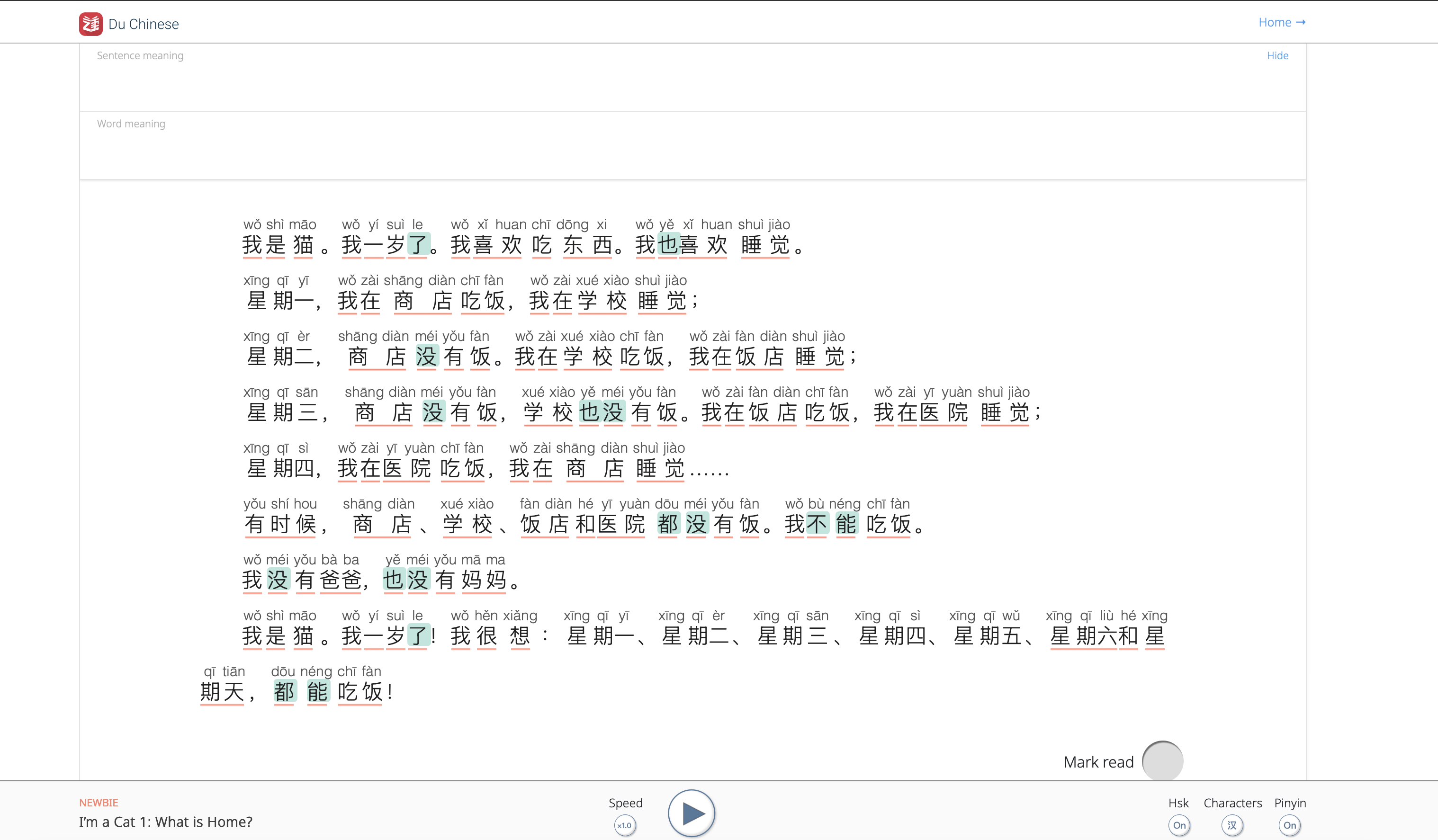
What changed things was doing a 1:1 exchange with a local and practicing that same story together. It got a lot easier after that. Let me rephrase: it got more comfortable.
I also started pulling words out of the story and treating them like building blocks, one word plus another word becoming part of a sentence. The same thing I'd done with red, just with more pieces on the table.
The traditional market
If there's one place in Taiwan that works like a giant set of flashcards, it's the traditional market. Supermarkets and convenience stores are everywhere here, but a lot of people still do their daily shopping at the morning market: produce, meat, fish, tofu, all piled up in the open with vendors calling out prices.
Every word comes attached to the real thing. Colors, fruit, numbers, quantities, the price of a bag of greens said out loud three times in a row. It's the red-bucket method, except the bucket is sitting right in front of you.
The catch is that a good part of what you hear, especially from older vendors, is Taiwanese rather than Mandarin, so even here not every word is one you can look up.
Read also: Liming Huanghun market is my go-to in Taichung
There's no recipe
None of what worked for me was ever in a YouTube video. Those stick to the basic strategies, and I understand why. They're easy to repeat, and they do work for plenty of people. They just didn't work for me.
Every method is biased toward the person who came up with it. The polyglot who swears by podcasts already had an ear for tones. The person telling you to binge dramas might have grown up hearing the language at home.
Advice gets passed on by the people it worked for, and the people it didn't work for quietly give up and don't make videos about it. There's no generic recipe, and the only way I found mine was by trying things that look stupid from the outside, like playing one song on repeat to catch a single word.
What the dramas sound like now
The dramas used to be background noise with English text on top. Now I pick up real words, and because I can see on screen what they're talking about, I can catch a word in a sentence and work out the context around it. Sometimes, a lot more context than I expected.
That's where I realized Chinese wasn't as difficult to start as I'd made it. Or at least less difficult.
I still can't order a coffee. I'm nowhere near fluent, and I honestly don't know if I'll ever get there. But Mandarin stopped being noise. It turned into something with gaps I can see and a handful of words I can hold onto, and red is still the first one.
Some days that feels like progress. Other days, eight years into living here, it feels like very little. I've stopped trying to decide which of those is the real one.

Pieter Borremans is a writer, content creator, and founder based in Taichung, Taiwan and London, UK. He writes about entrepreneurship, independent business-building, and the unfiltered reality of creating things online.